Curiosity has always been a compass for Armir Sejdaj, who today brings his stylish vision to life as guest relations manager at Jnane Rumi, a design-forward boutique hotel that opened last year in the Palmeraie, just outside Marrakech's medina. A trained photographer and lifelong traveler, the Belgian-Albanian tastemaker spent time living in the United States and Thailand before a chance encounter led him to Marrakech, where his passions for design, hospitality and human connection collided. Now deeply rooted in the city and its creative community, Armir shares his Marrakech must-sees, from favorite shops and design destinations to hidden gems, restaurants and local talents to know. Plus, he gives us a sneak peak into Atelier Yazi, his forthcoming fashion brand and showroom inspired by the craftsmanship and culture of the city he now calls home.
The Marrakech Effect
Marrakech has taught me that creativity doesn’t always have to be about creating something new. Sometimes it is simply about looking at something that has existed for centuries and seeing it differently.”
Can you tell us about your connection to Marrakech?
Armir Sejdaj: Marrakech touched my heart from my very first visit. After four short trips here, chance brought me to Gert-Jan and Corinne Van Den Bergh [founders of Jnane Rumi], whom I met in Amsterdam through mutual friends. At the time, they had been searching for the right person to look after their guests, while I had quietly given myself a deadline to leave Belgium and build a life somewhere new. Neither of us knew it, but we were looking for something the other could offer. What convinced me was the love they were pouring into Jnane Rumi. I believed in their vision and wanted to be part of it. A year after that first meeting, I moved to Marrakech to join them at their beautiful hotel, where I could bring together two things I deeply care about: design and hospitality. What began almost by coincidence became a completely new chapter of my life.
What first drew you to Marrakech and what has kept you here?
AS: What first drew me to Marrakech was its energy, the colors, the light, the architecture, the craftsmanship and the feeling that everything here has a story behind it. But what kept me here is, above all, the people. Their kindness, generosity, sense of sharing and the way people naturally help one another. There is a warmth and humanity here that I find very difficult to describe. I'm a people lover. I love stories, I love conversations and I love discovering the person behind a place. In Marrakech, you constantly meet people with incredible stories and I think that human connection is what makes the city so special to me.
How would you describe the creative energy of Marrakech today? What makes the city particularly exciting from a design, fashion and art perspective?
AS: I think Marrakech has always had an incredible creative energy, but today there is a beautiful new dialogue happening between tradition and contemporary creativity. What excites me is seeing a new generation of designers, artists and artisans who are not trying to recreate Morocco, but are finding new ways to interpret it. There is such a richness in the materials, colors, craftsmanship and architecture here that you can draw inspiration from almost everywhere. You can walk through the Medina and see something that feels centuries-old, then see a young designer reinterpret that same language in a completely unexpected way. For me, that contrast is what makes Marrakech so exciting. It doesn't feel like a city simply looking back at its heritage. It feels like a city constantly reinventing it.
Has living and working in Marrakech changed the way you think about design or creativity?
AS: Absolutely. Marrakech has taught me to slow down and pay attention to detail. Before living here, I think I was more focused on the final result. Here, I've learned to appreciate the process, the imperfections, the textures, the handmade details and the way things evolve naturally. Working with local artisans has also completely changed the way I see creativity. There is so much knowledge passed down through generations, often without anyone calling it "design." A simple door, a piece of zellige, a woven textile or the way light falls on tadelakt can be incredibly inspiring. Marrakech has taught me that creativity doesn't always have to be about creating something new. Sometimes it is simply about looking at something that has existed for centuries and seeing it differently.
The Beat of Jnane Rumi
It is not simply about creating a beautiful stay, but about making people feel something, creating a connection and hopefully leaving them with a little piece of Morocco that stays with them long after they leave.
Can you tell us about Jnane Rumi and your involvement with the property?
AS: Jnane Rumi is a very special place, and I'm fortunate to be part of its story as guest relations manager. I've also had the chance to be involved in the decoration and creative direction of the property alongside the team. My role is really about people, making sure every guest feels at home, experiences something truly special and leaves with a deeper appreciation for Moroccan art, craftsmanship and the incredible stories behind them. For me, hospitality is not only about creating a beautiful place. It is about creating meaningful experiences and genuine emotional connections.
What do you think makes Jnane Rumi special or distinct within Marrakech?
AS: I think what makes Jnane Rumi special is that it doesn't feel like a hotel in the traditional sense. It feels like a home with a soul—intimate, personal and deeply connected to Marrakech. Our team is also a huge part of what makes the house special. We are like a family, and we welcome every guest as if we were welcoming them into our own home. There is something very genuine about Moroccan hospitality—the generosity, warmth and care for others—and this is something we really try to embody every day. There is also a real sense of authenticity here. Every detail, from the architecture to the objects, craftsmanship and the way we welcome our guests, tells a story. We want people to experience Morocco beyond what they see, to feel its culture, creativity and generosity. I think that is what makes Jnane Rumi different. It is not simply about creating a beautiful stay, but about making people feel something, creating a connection and hopefully leaving them with a little piece of Morocco that stays with them long after they leave.
How does the property reflect the city and its creative spirit?
AS: I think Jnane Rumi reflects Marrakech through the way it brings together tradition and contemporary creativity. The house is deeply rooted in Moroccan architecture, materials and craftsmanship, while also leaving space for a more modern and artistic expression of the city. Samy Snoussi, our curator, has played an important role in this by bringing together and highlighting the work of Moroccan artists throughout the property. The art adds another layer to the house and creates a dialogue between Moroccan heritage and the creative energy of Marrakech today. For me, that is very much what Marrakech is about; it's a city where the past and present constantly meet, and where craftsmanship, art, fashion and design are all part of the same conversation. Jnane Rumi tries to capture that spirit in a very personal and intimate way.
Is there a particular space, detail or time of day at Jnane Rumi that you especially love?
AS: I actually lived at Jnane Rumi for a while, so the house is very personal to me. Every space carries a memory from that time, especially because moving here from Belgium represented such a big chapter change in my life. When I walk through the house, there are little moments and memories attached to almost every corner. But if I had to choose one particular time, it would be the morning. I love waking up to the hundreds of birds singing in the garden, hearing the chickens in the distance and slowly feeling the house come alive. Then, seeing the smiles on our guests' faces after a beautiful night here, that is probably my favorite part. It is a very simple feeling, but it reminds me every day why I love this place.
On Our Radar: Atelier Yazi
For me, clothing became a language, a way to transform emotions, memories and feelings into something tangible.
Can you tell us about the concept and what you're currently creating?
AS: Atelier Yazi is a project that is very close to my heart. It will be a showroom dedicated to the clothing brand, with unique unisex pieces as well as made-to-measure creations for artists and others who want something truly personal. The idea is to create a space by appointment, somewhere intimate where we can sit down, talk, look at fabrics and ideas and take the time to create something together. I don't want it to feel like a traditional shop, but rather like a meeting point between people, clothing and creativity. Creating my own clothing brand has been a dream of mine since I was a child. Since moving to Marrakech, I've felt an even stronger need to express everything I feel and experience. Marrakech has given me so much inspiration, and Atelier Yazi is my way of translating some of those emotions into clothing.
What inspired you to launch the brand?
AS: I had wanted to create this brand since I was very young. It was always somewhere in the back of my mind, something I knew I wanted to do one day. But what ultimately pushed me to bring Atelier Yazi to life was a very intimate love story that profoundly changed me. It was an experience that turned my life upside down and made me feel the need to express what I was going through in a different way. It was during that period that the name Yazi came to me. In Tamazight, Yazi means "free man," and at that particular moment in my life, those words suddenly carried so much meaning. It felt almost instinctive, as if the name had found me at exactly the right time. That was when I knew it was also the right moment to finally bring the brand to life. For me, clothing became a language, a way to transform emotions, memories and feelings into something tangible. Atelier Yazi really came from that place, from love, transformation, freedom and the need to create.
How has Marrakech influenced the aesthetic, materials or point of view behind the collections?
AS: Marrakech has influenced the collections in many ways, not only visually but emotionally. Since living here, I've become much more sensitive to color, texture, light and the beauty of imperfect, handmade things. The city has also made me look differently at Moroccan craftsmanship, the way materials are worked by hand, the richness of the textiles, the details and the patience behind each piece. I'm very inspired by that idea of craftsmanship and by the dialogue between something traditional and something more contemporary. But beyond the materials and aesthetics, Marrakech has changed my point of view. It has given me the freedom to be more expressive and less afraid of emotion. Atelier Yazi is very much a reflection of that, a mix of where I come from, what I've experienced, and what Marrakech has awakened in me.
What can visitors look forward to from Atelier Yazi?
AS: I hope visitors will discover pieces that feel unexpected and personal. Atelier Yazi is about creating clothes with character, pieces that can be worn and interpreted differently by each person. There will be unique unisex pieces from the collections, but also the possibility of creating something completely personal, whether it is a made-to-measure piece or a special creation for an artist. Ultimately, I want them to leave with something that feels like it belongs to them, rather than simply something they bought.
Are there particular Moroccan craft traditions, artisans or techniques that have influenced your work?
AS: Being Albanian, I feel a very personal connection to Moroccan craftsmanship. There are certain traditions, especially embroidery and the way textiles are decorated by hand, that immediately remind me of my own roots and the craftsmanship I grew up around. What fascinates me is discovering these similarities between two cultures that are geographically so far apart. The techniques may be different, but there is often the same love of detail, patience and handmade work. That connection has influenced the way I approach Atelier Yazi. I'm not trying to reproduce Moroccan craftsmanship literally, but rather to create a dialogue between my Albanian heritage, what I discover here in Morocco and my own contemporary vision. I think that mix of cultures is an important part of what gives the brand its identity.
Armir’s Marrakech
Rather than simply observing Marrakech, you really feel part of it.
What to Experience
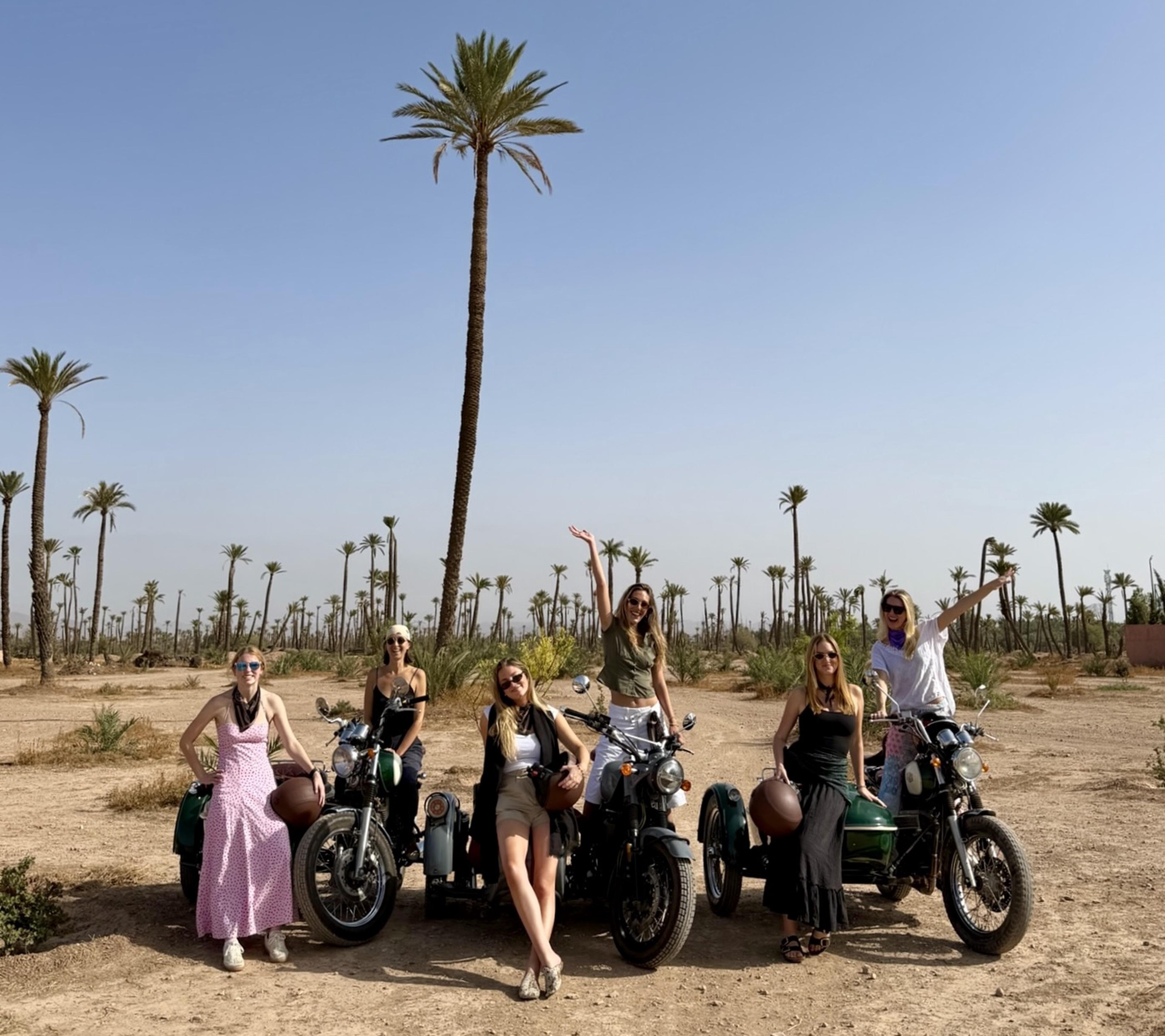
- For a first time visitor: I would definitely recommend discovering Marrakech from a vintage sidecar. It offers such a unique way to experience the city, taking you through its different neighbourhoods, streets and hidden corners in a way that feels both fun and incredibly immersive. There is something about moving through Marrakech in the open air that makes you feel much more connected to your surroundings, the sounds, colors, smells, people and constant energy of the city. Rather than simply observing Marrakech, you really feel part of it.
- For someone returning: For someone who already knows Marrakech, I would send them beyond the obvious landmarks and into the city's more creative side. Sidi Ghanem is a great place to start. It is home to designers, artisans, workshops and independent showrooms, and you really get a sense of the contemporary creative energy of Marrakech.
Where to Shop & Explore
- Neighborhood to wander: Sidi Ghanem
- Favorite place for design or creative inspiration: Maison BLAOUI
- Gallery or cultural space: Loft Art Gallery and MACAAL
- Architecture worth seeing: Dar El Bacha is always worth seeing for its incredible proportions, craftsmanship and architectural details—the zellige tiles, carved wood, painted ceilings and the way light moves through the courtyards.
- Interiors worth seeing: Jnane Rumi. It has a very different energy—intimate, layered and deeply connected to Moroccan craftsmanship, while still feeling contemporary. I love the way art, furniture, textiles, color and objects have been curated throughout the house. It feels collected rather than decorated, and for me, that is what gives an interior soul.
- Local creative to know: Amine Bendriouich. I really admire his freedom and the way he brings together fashion, art and Moroccan culture without ever making it feel nostalgic or expected. His work has a strong identity and a sense of playfulness that I find very inspiring.
- Fashion boutiques and shops: Studio LID, Thé Différent Concept Store, Funky Fahd, Au Fil d'Or, LRNCE
- Best place to discover Moroccan craftsmanship: The Medina, without a doubt, but especially when you have the chance to go beyond the storefronts and enter the workshops themselves. That is where you really begin to understand Moroccan craftsmanship, meeting the people behind the objects and seeing the techniques, patience and knowledge involved in making them.
- Favorite place for ceramics, textiles or homewares: LRNCE
- A special souvenir to bring home and where to find it: Personally, I would choose a piece of jewelry from AZRAR. They have beautiful antique pieces that already carry a story and a soul. I love the idea of bringing home something that is not simply decorative, but something you can wear and keep with you wherever you go. Over time, it becomes part of your own story too.
Where to Stay
- Hotels: Maison Brummell Majorelle, Jnane Rumi and Villa Dar El Sadaka. Three very different places, each with a strong identity, beautiful design and a real sense of place.
AS: Staying in the Medina can be a wonderful experience, but for some people it can also feel a little overwhelming. Personally, I would recommend the Palmeraie. It is only about 12 minutes from the city center by car, yet it feels completely removed from the intensity of Marrakech. You have the sense of being somewhere quieter, greener and more spacious, while still being very close to everything. For me, it offers the best of both worlds, a real feeling of escape without ever feeling disconnected from the city.
Where to Eat
- Coffee: Thirty5ive
- Breakfast: Maison Amaj
- Lunch: Blue Ribbon
- Dinner: Dai
- Cocktail: Kabana
AS: I also really enjoy Farmers for something fresh and contemporary, and Al Fassia for classic Moroccan cooking that remains one of the city's essential experiences.
Local Picks
- Favorite hidden gem: Cactus THIEMANN
- Place for a dose of nature: Ourika Valley
- Wellness experience: The spa at Royal Mansour
- Favorite day trip or escape from Marrakech: A trip to Essaouira for the beach, the sea air and the city's relaxed and creative atmosphere.
What’s Next for Marrakech
There is this beautiful movement where young designers, artists, chefs and makers are looking at Moroccan heritage with fresh eyes, not trying to reinvent it completely, but giving it a new language.
What feels new or particularly exciting in Marrakech right now?
AS: I think what feels particularly exciting right now is the confidence of Marrakech's new creative generation. There is this beautiful movement where young designers, artists, chefs and makers are looking at Moroccan heritage with fresh eyes, not trying to reinvent it completely, but giving it a new language. You can feel it in fashion, interiors, food, art and even in the way new places are being created. Marrakech has always attracted creative people from all over the world, but today there is a stronger dialogue between that international energy and local talent. It makes the city feel incredibly alive, rooted in its identity, but constantly evolving.
Are there any new restaurants, galleries, shops, hotels or creative spaces that you think travelers should have on their radar?
AS: I think what is interesting now is that some of the most exciting new places are quite intimate and considered, rather than necessarily being big openings.
I'm particularly curious about Napa Chapter One, the new wine and cocktail room from the team behind Farmers. It feels like part of a more sophisticated, chef-driven energy emerging in Gueliz.
I also think Sidi Ghanem keeps becoming more interesting. It is no longer somewhere I would visit only for furniture. There are ateliers, galleries and increasingly interesting food concepts too. IKI - Authentic Japanese is a good example, a very small Japanese omakase concept that feels completely unexpected for Marrakech.
Another opening I'm very excited about is Isiki, which will be opening soon at Jnane Rumi. It will be a restaurant set within its own private apartment, where guests will be able to reserve a table and come for dinner around chef Moula's kitchen. The cuisine will be very much ingredient-driven, using produce from the garden and incorporating subtle Moroccan notes.
One space I'm particularly excited about is Out Of Office, a new creative residency that my friend Sally is currently developing, which is set to open in early 2027. The idea is to create a place that brings together many different kinds of creatives, not only artists, but also chefs, poets, designers, writers and other creative minds. They will be able to come to Marrakech, stay for a period of time, work, experiment, exchange ideas and develop new projects. It will also be a meeting point for the local and international creative community, with conversations, gatherings and exchanges around creativity in all its forms. I think it will bring something very special to Marrakech's creative landscape.
Are there any emerging Marrakech-based designers, artists or artisans whose work you're particularly excited about?
AS: There is a new generation of creatives in Marrakech that I find really exciting. Patrice Kouadio, founder of Travel., is one of them. I love how he treats fashion almost like postcards from Marrakech, while bringing his Ivorian heritage and a wider African perspective into the conversation.
Are there any upcoming openings, exhibitions or cultural events you're looking forward to?
AS: I'm particularly looking forward to Samy Snoussi's exhibition next February. I've followed his work closely, so I'm very excited to see this next chapter come to life.
I'm also looking forward to the art fair in March. Marrakech is becoming such an important meeting point for artists, galleries and collectors, and I love the energy these moments bring to the city.
Take It from Armir
Marrakech has its own pace, and once you accept that, the city becomes much more beautiful.
What practical advice do you always give friends visiting Marrakech for the first time?
AS: My biggest advice is not to try to do too much. Marrakech can be intense at first—the sounds, the colors, the Medina, the traffic—so give yourself time to understand its rhythm. Walk, get lost a little, speak to people and stay curious. I always tell friends not to experience Marrakech only through a checklist of places. Some of the best moments happen unexpectedly, over a tea, inside a small shop or through a conversation with someone you meet.
What do you think visitors often misunderstand about Marrakech?
AS: I think people sometimes misunderstand Marrakech as a place that is only about visual beauty—the colors, the riads, the architecture, the souks. Of course, all of that is part of it, but for me, the real Marrakech is much more about people and relationships. There is a generosity here that you only really understand when you allow yourself to slow down and connect. It is not a city you fully experience by simply moving from one beautiful place to another. You have to talk to people, listen to their stories and be open to the unexpected.
I also think visitors sometimes expect everything to work according to their own rhythm. Marrakech has its own pace, and once you accept that, the city becomes much more beautiful.
What's the best way to experience the city beyond its most famous sights?
AS: Simply spend time in the different neighborhoods and allow the city to unfold slowly. Go to Sidi Ghanem and meet designers and artisans in their studios, spend time in Gueliz, wander through parts of the Medina without a fixed destination, and make time for places where local life is happening rather than only the places created for visitors.
I also think meeting people is essential. Marrakech opens up through conversations with an artist, a shopkeeper, a chef or an artisan. Those encounters often become the memories you keep much longer than any monument.
If you had to design the perfect day in Marrakech for a friend visiting you, where would you take them from morning through evening?
AS: I would start with breakfast at Jnane Rumi, somewhere calm and beautiful, before heading to the Royal Mansour for a hammam session followed by a massage.
For lunch, I'd go to La Famille, then spend the afternoon wandering through the Medina, with a stop for tea at Tea House 1112.
After that, I'd head to Sidi Ghanem for some shopping and to discover a few of the designers and creative spaces there.
As the evening begins, I'd have cocktails at Baromètre, followed by dinner at Dai.
And if we still have energy and feel like going out, we'd finish the night at Epicurien for live music and a bit of dancing.
For me, that would be the perfect Marrakech day, a mix of wellness, food, design, shopping and nightlife.
Finally, what do you hope someone takes away from Marrakech after spending time here?
AS: I hope they take with them the Moroccan sense of sharing, the smiles of the wonderful people they meet and, above all, the kindness of the Moroccan people. There is such a generosity of spirit here, in the way people welcome you, help you and make space for you. More than anything, I hope visitors leave Marrakech carrying a little of that warmth with them.
Published onNovember 3, 2026
More Inspiration
Just Back From: Magical Morocco with the Indagare Team
Six Indagare travel specialists are just back from a week-long Moroccan adventure, covering Casablanca, Fez and Marrakech. Here, they share the places, experiences and memorable moments that stood out along the way—plus, their latest intel from the ground.

Snapshots from Marrakech: Where to Eat, Shop & More
The Indagare ambassadors recently traveled Marrakech on their annual retreat, while discovering new restaurants, hotels and experiences for our community

Plan Your Trip With Us
We only feature hotels that we can vouch for first-hand. At many of them, Indagare members receive special amenities.
Get in touch